Showing posts with label jaimie mcevoy. Show all posts
Briana Tomkinson

Tyee gives props to New West recovery centre

The Tyee's got a great list of 50 ways to help the homeless, building on Vancouver mayor Gregor Robertson's pledge to end (!) homelessness in Vancouver by 2015.

New Westminster is mentioned twice:

8.) Lobby for treatment funding in private, and put the spotlight on alternative treatment in public. Check out Vancouver Coastal Health's innovative DayTox program, and take a look at one of the more successful private recovery houses, such as The Last Door in New Westminster.
and:
39.) Invite the neighbours. Include representatives from Burnaby, Richmond, New Westminster, Surrey, the Langleys and the North Shore communities in everything Vancouver does. "And every so often," one local activist noted, "Mayor Robertson needs to lean over and say to Mayor Corrigan, 'So, you're going to do some of these projects too, aren't you?'"
As everyone here knows, homelessness is also a major issue in New Westminster. One would hope that Robertson's gang would not pronounce homelessness 'ended' if it simply pushed people outside of Vancouver proper and out towards New West, Burnaby, and other areas of the Lower Mainland. This is truly an issue that should be addressed at a regional level.

Lots of good ideas in this piece (Thanks Tyee!). Here are some of the ones that stood out for me:
2.) Ask property owners to help. Make an offer to the owner of every closed hotel or shuttered apartment building in the city: Lease your building for use by BC Housing and/or a non-profit housing manager for a period of at least three years, and the city will both give you a tax break and allow your development application to proceed without interruption.
13.) Dedicate more women-only buildings and programs. Women endure daily intimidation and frequent assault inside shelters and residential hotels. Besides, there are already far more men-only programs.
14.) Provide meals. At the end of a pilot project in which meals were delivered daily throughout one Downtown Eastside residential hotel, residents reported using fewer drugs -- and most had gained weight. 
23.) Seize grow-ops. Just as some law enforcement agencies seize vehicles, explore the possibility of seizing grow-ops and drug houses, renovating them, and converting them to rooming houses. Let the former owners sue for the value of the (usually trashed) property seized. 
25.) Detox on demand. No matter what shape a new treatment landscape assumes, detox for everyone who wants it will play a part. The city needs to partner with agencies and NGOs to create more spaces immediately. 
32.) Provide housing after treatment. Perhaps the most shameful gap in the housing safety net is the one many addicts fall through after they get clean, as they are returned to the same sort of social housing in which they used.
33.) Replace Riverview: 275 beds were slated to be replaced by recovery units throughout the city. In the years we've spent waiting, the need has grown to the point more may be required. Ideally, these would be built as small supportive facilities scattered throughout the city 
New Westminster needs to prioritize homelessness just as Vancouver has. We have a homelessness coalition and strategy, but there are still far too many people living on the streets or in substandard conditions here. I am hopeful that our lone new councillor Jaimie McEvoy will bring his passion for this issue to city hall and continue to advocate on behalf of the marginalized there, just as he has as project coordinator at Shiloh's Hospitality Project .

While we're on the topic of homelessness and poverty, I wanted to remind everyone to take some time to donate to organizations that help alleviate this suffering while we celebrate during the holidays. New Westminster's Food Bank is administered at Shiloh, and you can donate there or online. The Food Bank says it can stretch $1 into $3 through bulk buying and supplier relationships, so it's worthwhile donating even small amounts of cash instead of cans. Or, support Union Gospel Mission's annual Christmas dinner: $32.90 will feed and care for 10 people in our community this Christmas.

Jocelyn

Spirit of the City

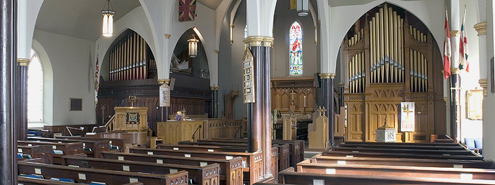
I just came back from my weekly lunchtime yoga at work, and as I sat down for a dose of 102tF, it got me thinking about the role that the spiritual life, and churches in particular, have played in our Royal City. Without any real historical training or knowledge (Will and Peter Julian will have to help you with that), I figure that when New West was settled and in the decades after, churches likely played an important role in developing a sense of community in our city.

The first church to open in New West was the one that Will (of 102tF) and I attended as children (and played many games of floor hockey in its church hall), Holy Trinity Cathedral on Carnarvon Street. Founded in 1859 by the Reverend John Sheepshanks, its first building was destroyed by fire in 1865. It's current stately building dates from the second structure built on that site which was lost in the great fire of 1898 - the surviving stone walls were found to be sound enough to support a rebuild, and so the current structure was built up from the ashes of the old (meaningful, no?). Though it is now an unsightly grey, crowded in on all sides by condo towers, it is a beautiful building on the inside and has unmissable stained glass windows. This parish was named the cathedral seat of the diocese in 1892, but the second in a series of "Capital Controversies" occurred in 1929 when Archbishop de Pencier named Vancouver's Christ Church Cathedral the seat of the diocese (though New Westminster remained the diocesan title and HTC remained a "Cathedral" in name and beauty). It's parish continues going strong today if parish activity can be measured by the sheer number of activity links on its website.

Knox Presbyterian Church set down its roots in the building it still occupies in Sapperton in 1891, as "The Wee Kirk on the corner" and has been an active member of the community ever since. Bringing it's denominational history of sound education in Sunday School (aided by the opening of its "Christian Education Centre" in 1956), Knox has been the heart of Sapperton since it was founded and it's distinct architecture make it one of New West's most recognizable buildings.

The first Gurdwara in New West was started in 1919 by Sikhs who worked the sawmills dotting the Fraser River. Bhai Bisan Singh, a dedicated Sikh, formed the Gurdwara Sahib Sukh Sagar in his home, gathering others for meetings and readings of the Holy scripture Sri Guru Granth Sahib Ji. The New Westminster Khalsa Diwan Society (The local community of Sikh believers) formed when Singh purchased the lot next to his house in 1919 and donated it to the congregation (though formally incorporated in 1974). The present Gurdwara opened in Queensborough in 1975 and it's tall red flame light is one of the many sights welcoming people New Westminster as they drive over the Queensborough bridge Northbound.

New Westminster has also been the home to the cemetery of BC's oldest and largest Orthodox Jewish Synagogue, Congregation Schara Tzedeck, in Vancouver. I tried to pin down whether there was an active temple/synagogue in NW but haven't found anything yet, though the contributions of many prominent Jewish people shaped New Westminster: Muni Evers, New Westminster's longest-serving Mayor (see here and here); More recently, the Congregation Sha'rai Mizrah (Gate of the East)has served New Westminster/Burnaby/Coquitlam from a converted Kingdom Hall off of Lougheed Highway.

No discussion of religion in New Westminster could go without the introduction of Dr. Vasant Saklikar, who, after moving to Canada from India in 1959 and working in education systems across the country, became rector of Sixth Avenue United Church in 1976 and quickly became a community icon - his work on the School Board and as an advocate and activist made him a frequent sight in local papers. Saklikar raised his family in the West End and was named Citizen of the Year in 1998. The now-named Shiloh-Sixth Avenue United remains a politically and socially active parish to this day, where newbie New West council member Jamie MacEvoy is director of their Hospitality Project, bringing comfort and aid to New Westminster's vulnerable people.

Another United church has a prominent place (and role) in New Westminster's history - the venerable Queen's Ave United Church building sits just up the 6th Street hill from City Hall, and has hosted a faith community there since 1859 (not to mention the piano recitals and music day camps Will and I went to as kids!), tying HTC for first church in the new colony though the building wasn't built until 1860, as Queen's Avenue Methodist Church. When the Wesleyans, Presbyterians and Congregationalists merged in 1925, its name was changed to it's current. Another congregation which was tested by fire, QA lost it's first church building to New Westminster's Great Fire in 1898, and its second building was replaced by the current iconic stone block building across from the Armoury in 1959. I didn't know this until now, but QAUC also owns Grace Hall, a small building in the Queen's Park area which was once used for sunday school and is now home to community groups (such as the Brownie group I went to as a kid!). I have certainly always associated QAUC with music, and the congregation has a reputation in the community for great musical events and performances.

New West has played host to spiritual communities of all kinds, but there simply isn't room to do justice to them all. Many are small but in their own way left their imprint on the community - who can forget the Foursquare church and the Evangelical Free church (both on 10th, and technically in Burnaby) who maintain an active, and often clever, dialogue with the community via their church signs. We can't leave out the orthodox churches (of which there are 4), and several intentional religious communities in New West currently and historically, such as the Sisters of St. Anne, the Loyal Protestant Home (now Royal City Christian Centre) and the Russian Orthodox convent on 5th Avenue (anyone know the name of this one?). I'll leave these for a later post. In our "geeked out" discussions of New Westminster's politics and history, we can't leave out the rich history of many different faith traditions that have shaped and advanced New Westminster as the community it is today.

Briana Tomkinson

New West says 'no' to change

Despite a well-organized campaign by the Voice party to convince voters New Westminster needs profound change, the resounding public response has been a polite, "No thank you." Unofficial election results show only one new face on council: 12th Street booster, longtime Douglas College Student Union leader, Save St. Mary's Hospital organizer and antipoverty activist Jaimie McEvoy, who appears to have stolen the seat of our longest-serving councillor, Calvin Donnelly . Donnelly has been a city councillor for 18 years, since first elected in 1981 (according to the city website's official bio ... I assume he has not been in office the whole time or else it would be 27 years, no?).

It's the same story on school board, despite the vocal outcry over plans to situate a new school in Grimston Park, six of the seven school trustees are incumbents - and the seventh is former city councillor Casey Cook . There is a slight touch of drama here: Wright-endorsed newcomer Vivian Garcia was so narrowly edged out by incumbent Brent Atkinson (sorry, can't find a link for his bio) that there will be a recount to confirm the tally.

And the final confirmation that New Westminster voters are pretty happy with the way things are? The response to the referendum question on whether council terms should be extended from three years to four was YES . That one's a bit of a puzzler though - civic elections throughout the province occur every three years on the third Saturday in November . The referendum question is explicitly non-binding. Are we really going to put ourselves out of sync with every other municipality in the province and move to a four-year election cycle? I don't know about you, but the first I heard that this question was on the table was when I had my Sharpie in hand at the polling station. It's a surprise to me that we're even considering the question.

The story of the night for me is just how poor a job the news media did of reporting election results from municipalities other than Vancouver and Surrey. Of all the TV stations, CBC included, only Shaw Cable (!) had special election coverage. Other stations just had superficial updates during commercial breaks. Online, the story wasn't much better. The only site that did it well was the official City of Vancouver site, which reported faster results than any of the media sites (and, of course, didn't cover New West!).

New West results were not online at all (except as reported by us, repeating Shaw Cable's coverage). Because Shaw wasn't online, and their numbers went by so fast, we actually snapped photos of our TV screen in order to capture local information for this blog. We were monitoring the Vancouver Sun, CBC, the Georgia Straight, 24 Hours, the Record and the Newsleader and it pains me to say that we were the first to report New West results online. The Record wasn't too far behind in reporting the first results after all poll results had come in. The Newsleader had nothing until the results were complete. The big media organizations had nothing at all for New West.

The very best coverage was on Twitter. Big Media's overstretched staffers couldn't beat the efforts of dozens of passionate political junkies scouring the Internet for information on the election and sharing the dribs and drabs of info as it came in. CBC's best move came in asking the Twitter community to tag election-related Tweets with the code #civicelection2008, which allowed for easy, consolidated tracking of most of the related commentary.

To me, all this is more evidence that the rest of the Lower Mainland considers New Westminster insignificant, and that is something I hope to change somewhat through my efforts online. I'd love to see more people blogging and Tweeting and Facebooking the New Westminster perspective and trumpeting our city's successes so that the rest of the Lower Mainland might see that New West is more than what they view through the windshield trundling along Stewardson.

For those of you who didn't choose to vote, you lose all right to complain for the next three (maybe four!) years. If you felt your taxes were too high, crime too bad, arts undersupported, parks lacking or schools crowded, you had your chance to effect change. Suck it up, buttercups.

The final election results will be posted on the City of New Westminster's website on Nov. 19 after 4 p.m.

Briana Tomkinson

Homelessness in New West

Council candidate Lynda Fletcher-Gordon has provided a link to a PDF file with some stats on homelessness in New Westminster. She and Jaimie McEvoy have been the candidates who have, in my opinion, placed the most emphasis on the issue in our city so far. 


Both candidates have a track record in this area. Fletcher-Gordon is the Executive Director of the Purpose Society and she and McEvoy are involved in the Homelessness Society, which produced the report I've linked to above.

Some interesting facts from the report: 
  • Homelessness has increased by about 35% in New West compared to the 2005 count (it has increased throughout the GVRD)
  • 58% of the homeless who were counted in 2008 were living on the streets
  • 74% are men (slightly above the regional average of 72%)
  • 27% identify as aboriginal (slightly below the regional average of 32%)
Vancouver-wide stats: 
  • 48% of the people counted were homeless for a year or longer;
  • 80% lived in the municipality where they were counted for one year or more;
  • 71% considered their ‘home’ to be in Metro Vancouver;
  • 61% reported an addiction problem;1
  • 33% reported a mental illness.
Top three reasons for being homeless (as identified by the homeless in the GVRD):
  • Lack of income (25%)
  • High cost of housing (19%) 
  • Addiction problems (17%) - interesting note:  68% of the street homeless reported an addiction problem compared to 48% of the sheltered homeless.
Recommendations: 
  • Establish a homelessness resource centre with programs and facilities focused on addiction recovery, employment assistance, medical services and life skills training
  • Create additional spaces in transition housing for women and children fleeing abuse (estimated demand is 3-4 times available space)
  • Create social housing spaces for single adults (the majority of social housing projects currently focus on families, people with disabilities and seniors)
  • Improve access to addiction and mental health services

Traffic congestion and public transit infrastructure are named among the top issues for most civic election candidates in New Westminster - and it seems we're not alone. Greater Vancouver is experiencing major growing pains related to suburbun expansion. Cost of living has boosted growth in areas like Pitt Meadows, Coquitlam, Surrey and Abbotsford, but the majority of jobs are still located in Vancouver. The result is gridlock due to the funnel effect of so many people coming into the downtown area through a limited number of access points.

Unsurprisingly, those at the wide end of the funnel want to twin the Port Mann bridge, hoping it will speed their commute into town. We at the narrow end - New Westminster, Burnaby and Vancouver - are more likely to oppose it, fearing it will only bring more non-residential traffic into our communities.

Writes the Vancouver Sun:

In the south-of-the-Fraser communities of Langley, Surrey, Delta and White Rock, where gridlock on the bridge is a huge issue, nearly 75 per cent of candidates agreed or agreed strongly that the bridge should be twinned.

Artist's rendition of a twinned Port Mann Bridge.

Artist's rendition of a twinned Port Mann Bridge.

Handout

In the Tri-Cities area, support was even higher. Eighty-five per cent of candidates agreed.

In the core communities of Vancouver, Burnaby and New Westminster, where many fear that more lanes will bring more traffic, only 30 per cent either agreed or agreed strongly with the bridge twinning.

New Westminster council candidate Betty McIntosh said she'd like to see the new South Fraser Perimeter Road completed to siphon off some of the traffic that now runs through New Westminster, which, as the geographical centre of the region, has a disproportionate number of vehicles travelling through it
"New Westminster is a compact, well-planned city with a large volume of transit users. We can work, live and play within our city boundaries," she said.

Lorrie Williams, also running in New Westminster, said the city could "easily become just the crossroad to other places" and it needs well-planned commuter and truck routes and cooperation with other municipalities to share the burden.

As a central access point for the Lower Mainland, New West benefits from proximity to both the city and the suburbs, but as this issue highlights, there is a dark side. Too much traffic is just pass-through traffic, and it impacts local traffic, air quality, quality of life and also our businesses. 

The Sun quoted Williams and McIntosh, but here are some opinions from other local candidates on the traffic situation here in New West and what to do about it (quotes from the Sun's poll data and candidate websites): 


Mayoral candidates:

  • Wayne Wright (incumbent): "Always a problem in a Geographic centered city like N.W. Biggest issue is North Fraser Perimeter Road and bridges and how they will be brought through the city.The road goes directly though the middle of downtown and our new residential areas and the bridge heads are congested already.We will be working directly with Translink and the Province to address these problems. There will be solutions but there will be large capital costs necessary to do the right thing."
  • Blair Armitage:  Ipsos Reid poll rates traffic as high priority with New West voters (note: I tried looking for more detail on the Voice website but I was unable to find the info I was looking for. If you're reading this Voice, SEO is everything. Get your Google juice on!)
Council candidates:
  • Jaimie McEvoy: "New Westminster needs more support for cyclists, include more bike routes and bike racks throughout the city ..... We need to ensure that when Patullo Bridge is replaced that city council is a strong advocate for its citizens, ensuring that the new bridge improves traffic, and does not increase traffic on our local streets."
  • Matthew Laird: "New Westminster is at the cross roads of the Lower Mainland, we have an opportunity to be an example of progressive urban planning, making a walkable, livable city focused on sustainability."
  • Bob Osterman: "New Westminster has over 350,000 cars driving through our city each day, our roads are clogged and the consequent accidents and car pollution concern every resident. To go from West to East at rush hour can take 30 minutes to travel 2 miles."
  • Lynda Fletcher-Gordon: "The amount of traffic in New Westminster will not decrease. In fact, without the provision of more public rapid transit, it is likely to increase. While we want to have a walkable city, we also need to consider how to keep the traffic moving and avoid gridlock. While I support traffic calming devices generally, the traffic calming devices on the main roads and intersections contribute to the gridlock that often happen - especially at 6th and Royal. They cause congestion as those drivers who want to use an alternative route or merely turn from Royal onto 6th are prevented from doing that."
  • Terrance Owen: "New West suffers from severe road and rail cross-traffic to and from other municipalities. These road and rail routes fall under federal and provincial jurisdictions. The city needs the cooperation and support of these senior levels of government to provide alternate routes and containment that will alleviate the problems created for New West."
The Vancouver Sun is leveraging the data gathered in their municipal candidates' issues survey well here, but this quote from their article again highlights how they missed the mark from a technology standpoint.

To help you on voting day, Nov. 15, you can use the database as a personal ballot, printing off a list of all candidates and then circling those that best reflect your views.

Print it out and circle the candidates you're voting for? C'mon Sun, you can do better. The data is there, all that is needed is the technical execution to make it more useful. If the Sun doesn't have the technical resources, they could at least provide the data in an easily remixed format so that others with the knowledge and the desire could create something better suited for the Web.

Readers, if you notice that I'm missing a candidate's published comments on the issue, leave a note in the comments. If any political candidates wish to expand on their comments, go right ahead!

Blogger Templates by Blog Forum