Showing posts with label history. Show all posts
Briana Tomkinson

A Christmas story

Here's a lovely hint of a story to think about as we approach Christmas: when soldiers were posted to B.C. in 1943 to guard against a feared attack by the Japanese, New Westminster opened its doors and made sure every last one had a home to go to for Christmas:

Despite omnipresent danger, tasteless bully beef and hardtack rations in the field, and nearly dying of pneumonia one year, Christmas in the army was the only place Charles Goodman wanted to be in his youth.
Having left home in Saint John any lying about his age so he could enlist in 1943, the 15-year-old found joy and escape from unhappy family life in military camaraderie.
Sent to B.C. to defend against a feared Japanese attack during his first military Christmas, Goodman recalls the town of New Westminster opening its doors to feed and fete every soldier on the festive day.
That gives me some warm and fuzzies. It's so typically New West.

Briana Tomkinson

Remembering New West's Great Fire in 1898

Local blog Regarding Place has an interesting feature called "A Year in Five Minutes" in which they write a quick overview of the highlights of a given year in history here in the GVRD. The latest was 1898, which was marked by (among other things), New Westminster's Great Fire :

Another Great Fire
The year was bad for New Westminster. The entire downtown section of the city was burned in a great fire September 10/11, including almost all the commercial section. Hundreds were left homeless. Almost 60 city blocks were leveled. Vancouver Fire Department historian Alex Matches writes: “The fire started in a riverfront hay storage warehouse and spread to two sternwheel river boats, the Edgar and the Gladys, which drifted down river setting fire to every wharf they touched. The raging fire then jumped Front Street and was quickly spread uptown by fierce winds.” Damage was estimated at $2.5 million, an enormous amount in 1898 dollars. Only two brick buildings were left standing. The VFD had saved one of them.
The VFD had a busy year closer to home: after a few years in which fewer than 100 fire alarms came in annually (58 alarms in 1894, 97 the following year, 64 in 1896 and 62 in 1897) expansion of the city—largely fueled by the Klondike Gold Rush—led to 131 alarms, the highest the city had experienced since incorporation 12 years earlier.
Front St., from Lytton Sq., New Westminster, after September 10 fire, 1898. Photographer: C.E. Bloomfield. Photo #Out N584.
Read the full article for more - it's interesting stuff for the history buff. 

Briana Tomkinson

Irving House's twist on Christmas tradition: apple garlands

Those seeking ideas for sustainable decorations this Christmas, should cast their eye to the keepers of the past. New Westminster's Irving House museum is profiled on Gardenwise for their unusual twist on a traditional garland that uses real apples for a beautiful and memorable look.

At Irving House in New Westminster the halls really are decked with boughs of holly — and lots of other traditional accents that transform the home into a celebration of a Victorian Christmas.
There are probably not many better places to evoke the spirit of the season than at this heritage home, where visitors are transported back to the 1860s and the ambiance of Victorian times.
Full instructions (and more illustrations of these lovely and eco-friendly decorations) are on Gardenwise .

Briana Tomkinson

Photo slideshow: New Westminster heritage buildings

B.C. celebrates its 150th birthday this year, and as part of the Vancouver Sun's coverage , it put together a list of the top 10 photos in our province's history.

Somewhat surprisingly to me, only one is taken in New Westminster (but I suppose they had to spread it around a bit). It is the iconic image of a little boy running after his father , who is marching off to war. The photo was taken on Columbia Street by photographer Claude Detloff for The Province newspaper, and the man in the photo is Pte. Jack Bernard, a member of the B.C. Regiment (Duke of Connaught's Own Rifles).

From the newspaper's description:

This photograph by Dettloff, who was honoured by his peers for this candid street portrait of a tender moment, was hung in every B.C. school and became one of the most widely recognized Canadian images from the Second World War. Whitey Barnard, who was enlisted to help sell war bonds with this photograph as a backdrop, later settled in Tofino.
I've always loved the photograph, and I'm glad it was included in the top 10 list. Given that next year is New Westminster's 150th birthday, maybe our local historian Archie Miller and the New Westminster Historical Society will compile a similar list from the city's archives. The city will be doling out grants for the coming year for projects celebrating our 150th, and I hope one of the winning ideas will show off our rich photographic archive.

Update: Amazingly, the Sun's slideshow of Royal visits doesn't appear to include any to The Royal City! And no mention is made of Royal visits to New Westminster (named after the Queen's favourite part of England)! Here's one from my husband's family's archives:

Jocelyn

Spirit of the City

I just came back from my weekly lunchtime yoga at work, and as I sat down for a dose of 102tF, it got me thinking about the role that the spiritual life, and churches in particular, have played in our Royal City. Without any real historical training or knowledge (Will and Peter Julian will have to help you with that), I figure that when New West was settled and in the decades after, churches likely played an important role in developing a sense of community in our city.

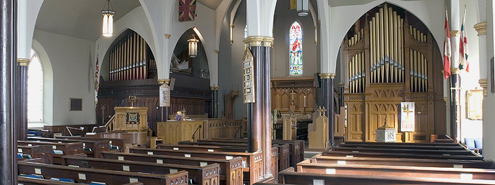
The first church to open in New West was the one that Will (of 102tF) and I attended as children (and played many games of floor hockey in its church hall), Holy Trinity Cathedral on Carnarvon Street. Founded in 1859 by the Reverend John Sheepshanks, its first building was destroyed by fire in 1865. It's current stately building dates from the second structure built on that site which was lost in the great fire of 1898 - the surviving stone walls were found to be sound enough to support a rebuild, and so the current structure was built up from the ashes of the old (meaningful, no?). Though it is now an unsightly grey, crowded in on all sides by condo towers, it is a beautiful building on the inside and has unmissable stained glass windows. This parish was named the cathedral seat of the diocese in 1892, but the second in a series of "Capital Controversies" occurred in 1929 when Archbishop de Pencier named Vancouver's Christ Church Cathedral the seat of the diocese (though New Westminster remained the diocesan title and HTC remained a "Cathedral" in name and beauty). It's parish continues going strong today if parish activity can be measured by the sheer number of activity links on its website.

Knox Presbyterian Church set down its roots in the building it still occupies in Sapperton in 1891, as "The Wee Kirk on the corner" and has been an active member of the community ever since. Bringing it's denominational history of sound education in Sunday School (aided by the opening of its "Christian Education Centre" in 1956), Knox has been the heart of Sapperton since it was founded and it's distinct architecture make it one of New West's most recognizable buildings.

The first Gurdwara in New West was started in 1919 by Sikhs who worked the sawmills dotting the Fraser River. Bhai Bisan Singh, a dedicated Sikh, formed the Gurdwara Sahib Sukh Sagar in his home, gathering others for meetings and readings of the Holy scripture Sri Guru Granth Sahib Ji. The New Westminster Khalsa Diwan Society (The local community of Sikh believers) formed when Singh purchased the lot next to his house in 1919 and donated it to the congregation (though formally incorporated in 1974). The present Gurdwara opened in Queensborough in 1975 and it's tall red flame light is one of the many sights welcoming people New Westminster as they drive over the Queensborough bridge Northbound.

New Westminster has also been the home to the cemetery of BC's oldest and largest Orthodox Jewish Synagogue, Congregation Schara Tzedeck, in Vancouver. I tried to pin down whether there was an active temple/synagogue in NW but haven't found anything yet, though the contributions of many prominent Jewish people shaped New Westminster: Muni Evers, New Westminster's longest-serving Mayor (see here and here); More recently, the Congregation Sha'rai Mizrah (Gate of the East)has served New Westminster/Burnaby/Coquitlam from a converted Kingdom Hall off of Lougheed Highway.

No discussion of religion in New Westminster could go without the introduction of Dr. Vasant Saklikar, who, after moving to Canada from India in 1959 and working in education systems across the country, became rector of Sixth Avenue United Church in 1976 and quickly became a community icon - his work on the School Board and as an advocate and activist made him a frequent sight in local papers. Saklikar raised his family in the West End and was named Citizen of the Year in 1998. The now-named Shiloh-Sixth Avenue United remains a politically and socially active parish to this day, where newbie New West council member Jamie MacEvoy is director of their Hospitality Project, bringing comfort and aid to New Westminster's vulnerable people.

Another United church has a prominent place (and role) in New Westminster's history - the venerable Queen's Ave United Church building sits just up the 6th Street hill from City Hall, and has hosted a faith community there since 1859 (not to mention the piano recitals and music day camps Will and I went to as kids!), tying HTC for first church in the new colony though the building wasn't built until 1860, as Queen's Avenue Methodist Church. When the Wesleyans, Presbyterians and Congregationalists merged in 1925, its name was changed to it's current. Another congregation which was tested by fire, QA lost it's first church building to New Westminster's Great Fire in 1898, and its second building was replaced by the current iconic stone block building across from the Armoury in 1959. I didn't know this until now, but QAUC also owns Grace Hall, a small building in the Queen's Park area which was once used for sunday school and is now home to community groups (such as the Brownie group I went to as a kid!). I have certainly always associated QAUC with music, and the congregation has a reputation in the community for great musical events and performances.

New West has played host to spiritual communities of all kinds, but there simply isn't room to do justice to them all. Many are small but in their own way left their imprint on the community - who can forget the Foursquare church and the Evangelical Free church (both on 10th, and technically in Burnaby) who maintain an active, and often clever, dialogue with the community via their church signs. We can't leave out the orthodox churches (of which there are 4), and several intentional religious communities in New West currently and historically, such as the Sisters of St. Anne, the Loyal Protestant Home (now Royal City Christian Centre) and the Russian Orthodox convent on 5th Avenue (anyone know the name of this one?). I'll leave these for a later post. In our "geeked out" discussions of New Westminster's politics and history, we can't leave out the rich history of many different faith traditions that have shaped and advanced New Westminster as the community it is today.

Briana Tomkinson

Meet our MP, Peter Julian

New Westminster packs 60,000 people into just 15 square kilometres. Despite the skyscrapers and traffic jams, this city of ours still behaves like a small town. The annual Remembrance Day ceremony at the armory is a hugely popular civic event. We have just one high school.  Our mayor is a jolly guy who drives an old Ford truck. And our MP, Peter Julian, is a friendly Salmonbellies fan who, like many of us, still carries a bit of a chip on his shoulder from 1868 when Victoria stole the title of B.C. capital from our town. His dad even wrote a book about it (entitled, "A Capital Controversy").

Julian called us up a few weeks ago after seeing our blog and asked if we'd like to sit down and have a chat. We invited him over to our home and spent two hours talking about New West issues over a glass of red wine and a plate of crackers. We didn't press him on political issues so much as try to get a sense of the man and his passion for this place. It was a cracking good conversation and more fun than a barrel of bonobos to a couple of folks like us who geek out on all things local.

Those of us who live here know that there is more than one New Westminster. To some, it's the crown on the sign they drive past every day to work (Welcome to New Westminster! Thank you for visiting! Welcome to Burnaby!). For others, it's where they bought their bridal gowns or where they browse antiques or the place where Chickpea relocated from The Drive. 
Julian's New Westminster is deep-rooted family history, civic pride, political engagement, heritage homes and amateur sport. He described it this way:
It's a Salmonbellies game in midsummer. It's the Hyack Festival. It is going down 12th St and seeing five people you know. It's getting 250 people at an all-candidates' meeting or standing-room only for the civic election forum. It's 2,500 people at the Cenotaph on Remembrance Day. 
Julian's very well-liked in New Westminster, and it's easy to see why. He's passionate about this city. He's knowledgeable about local history, passionate about New Westminster's potential and appears to genuinely love his work as our MP. Leading up to the last federal election, this riding was declared an NDP lock (though Julian says he always campaigns as though he's a few votes behind), and the results have shown the NDP and Julian making incredible gains in this riding since he was first elected in 2004. When he defeated Mary Pynenberg back then, it was only by 300 votes, whereas four years later, in October, the margin of victory was almost 7000 votes.

Julian has just begun incorporating social media into his campaign strategy through his Facebook page - and I suppose he can now add blogger relations to the list - but I think he prefers making connections with his constituents the old-fashioned way, through door-knocking and handshakes. Although recently Burnaby mayor Derek Corrigan speculated that Julian might be a good candidate for an NDP premier here in B.C., Julian doesn't feel called to that office (or at least not yet). When we quizzed him on his ambitions, Julian insisted that he loves his work serving New West and Burnaby as our MP and has no plans to pursue a leadership role with the NDP, saying,
These are not the kind of positions you decide on. You are called to it. If in 10 years my phone was ringing off the hook, maybe, but not now.
Back to the 'Capital Controversy.' Given the Julian family interest in the matter, it's no surprise that one of the ideas Julian suggested would put New West on the map was to build a new museum and arts centre in the city's downtown.

Julian believes such an attraction would draw tourists who are interested in B.C. history. And it is true that New Westminster's history is really B.C.'s history, from the First Nations settlements to Judge Begbie's reign at the law courts to Hollywood Hospital's LSD experiments on celebrities to the Royal Westies' contribution in both World Wars.

We are museum buffs here at Tenth To The Fraser, so we like the idea of building a fitting home for the historical artifacts scattered among various small collections around the city. From the fabulous collection of military memorabilia currently housed at the armory (and practically impossible to see due to eccentric operating hours) to possibly even the Samson V , which cannot continue to float at the Quay forever, we already have some very interesting content for such a museum. As the geographical centre of the Lower Mainland and the first city in Western Canada, there is no better site.

A tribute to our history is a worthy thing, but we also need to think more creatively, more innovatively. New West is beset by many of the same problems as our neighbouring communities, but perhaps because we are so compact, so small-town, we feel the impact more greatly. Julian spoke quite convincingly of a need for provincial and federal relief for New Westminster, to fund badly needed infrastructure improvements, to provide adequate resources to assist the homeless and those living in poverty, and so on. I agree that is part of the solution, but one line from Barack Obama's campaign has been drumming in my head of late:
We are the change we seek.
It is such a simple statement, and yet so powerful. We are the change we seek. Our governments, local, provincial and federal, all have a role to play, but we must not shirk our individual responsibility to do whatever is in our power to realize the change we wish to see in our community. None of us alone can feed all who are hungry or house all who are homeless, but there is always something we can do. Take the initiative to paint over some graffiti or pick up some garbage, volunteer at the UGM , vote in your elections and above all connect with your community.

Jocelyn

Post-election Post (Editorial)

Now that the dust has settled and the result is no different than last election (Is it just me or does anyone else have deja vu from October?), perhaps there's no wonder that a proportion of New Westminster's citizens voted (in a completely non-binding way) to increase the electoral cycle from 3 years to 4 - perhaps this proportion of the population believes that since nothing will change, why go to the expense to have elections so frequently?

I'm sure that in the coming weeks, editors, electors and candidates will toss around theories for the lack of change of the council, the apparent dearth of an expected "Grimston Park Effect" and as to how to deal with a 50-year age gap between sole newbie, Jamie MacEvoy, and the rest of City Council, but I am pretty confident that it can all be boiled down and neatly answered with my pet theory about New West - I call it the "One Highschool Effect" or OHE for short.

I have long held that it is the peculiar makeup of New Westminster's school district that has kept the politics, neighbourhood relationships, development plans and even traditions bound to a small town mindset. One highschool of 2200 kids (when I was there) provided the sort of demographic funnel that kept almost everyone in the population within 4 or 5 degrees of separation - just enough to mean that you wouldn't stop everyone on the street for tea and cakes, but just right to mean that everybody's mom, dad, uncle, realtor, dogwalker, dry cleaner, Waffle House owner knew whose kid you were, and likely what elementary school you went to (and thus your neighbourhood and socio-economic status).

In a town where most families have children who grow up, leave, and then come back to raise their kids, often with three or four generations of one family having attended the same high school, memories are long and tradition is revered. In a town where it must seem like most "newfangled" developments seem to fail - the once shiny and bustling Quay Market now dreary and empty; hundreds of shiny new condos built on the old Penn lands all leaky, and an apparent inability to keep any sort of floating vessel at the Quay for long, and the loss of Royal City Centre as a viable retail space - perhaps there is some suspicion of new ideas, and the people who bring them? Perhaps this small-town feeling that has preserved New West's historical charm, has kept residents wary of change - especially where their government is concerned.

Certainly it seems that the longest serving members of Council are those who are also older - whatever happened to Jerry Dobrovolny, who was the youngest - and cutest! - thing to hit council when I was a teenager. He was the first one to use large-format campaign signs, the first to put his face on his signs and the first one to use colour. The net effect was to send the message that perhaps Jerry, a late-thirties family man and city engineer in Vancouver, was perhaps the only candidate running for council in 1995 who knew how to use a computer. When did he leave?

One quick look at New Westminster's Mayors shows how this city likes to hold onto its leaders. Muni Evers' service spanned three decades, from 1968-1982; beloved Mayor Betty Toporowski served almost 10 years (despite the "racy" painting incident!), and with a third term looming ahead of him, mayor Wayne Wright is likely to top up to 9 years himself. There hasn't been a single-term Mayor since J.L. Sangster in 1949-1950! (Take that, Sam Sullivan...)

It seems obvious that New West values its history and perhaps is wary of change. This is bound to change given the rapidly changing demographics of both the city and the provincial population in general, however I can't help but wonder whether there isn't still a silent majority block of voters whose wishes are felt every three years when they again vote in a comfortably familiar set of Mayor, Council and School Board.

Perhaps if the lack of change in governance across the board is part of a larger community effort to thwart change through historical preservation, the mayor and council may need to watch out or they might find themselves on display in Irving House one of these days.

Briana Tomkinson

New West history online


New Westminster is one of B.C.'s oldest cities. Despite the ravages of fire and flood, many of New West's historical buildings still stand. Our history is one of the things that differentiates us from the newer municipalities that have since eclipsed New West in size and renown. 

Most of our residents know we were once British Columbia's capital city (until dastardly Victoria, Jacob to our Esau, stole this birthright), but you may not know what it was like in the 'olden days' here. Our resident historian Archie Miller does his part, leading the New West Historical Society, writing columns for the local papers and offering historical walking tours of the city, but today I discovered some digital fodder for the imagination in the New Westminster Heritage Database

I love old photographs. Looking at the faces in black and white always gets me daydreaming about how it might have been back in those days. There are some spectacular shots in this collection online. If only it was more browsable and bloggable! Put it on Flickr! 

Briana Tomkinson

New course series for heritage home lovers

Heritage home aficionados can now sign up for applied courses on home restoration through the Vancouver Heritage Foundation:

... the Vancouver Heritage Foundation, established in 1992 and best known for raising money and awareness through workshops and its wildly popular annual heritage home tours, to offer a unique educational series.

It's called Old School: Courses for Building Conservation, and it's designed to meld heritage theory with hands-on practice.

The $400 certificate program comprises a mandatory core course called Heritage 101, as well as seven elective courses.

Graduation - and it's expected it will take you about two years to complete the program schedule - is dependent on attendance and most courses are available evenings and weekends, in fall and spring sessions.

If you're not looking for the diploma, you can pick and choose individual courses, which range in price from $12 to $100, and include Windows and their Conservation, Research the History of a Building, Creating a Budget for a Conservation Project, and Creating a Conservation Plan.

Instructors include familiar names in Metro Vancouver heritage circles, like consultant and author Don Luxton and Eric Pattison, a New Westminster architect who specializes in heritage building.

Source: "No longer a deal, vintage homes priced for heritage and "green" benefits", Vancouver Sun

Jocelyn

editorial interlude - the middle of everywhere

And now for an interlude, appropriately enough, from the Starbucks at Chapters in Metropolis (née metrotown). New Westminsterites of my vintage will remember it as Metrotown, that mecca of all things cool and consumer-related.

When I was a kid, Metrotown was THE only place to see a movie, buy reasonable clothes, shop on your own, and oftentimes, eat. Sure, some of that was owing to the uniquely terrible palate of one's teenage years, but I know I'm not alone in saying that Metrotown was the mecca for everything. Growing up in New West was to be a throbbing teenage parasite on the side of Burnaby or Downtown Vancouver.

As a grown (and driving) adult, I see New West from a much different perspective, but the conclusion is the same - it is a city, unique in so many attributes, yet slighted by it's position as the town "on the way" to everywhere else. The middle of everywhere by public transit (and still is, as the junction between the Expo and Millennium lines) and by car is how New West is known to many, but truly understood by a very few. As much as these traffic flows brought, they took away far more, as a population too small to sustain its own immediate amenities - cinemas, nice nightspots, real shopping and tourist destinations - flocked to frequent those in Metrotown, Downtown Vancouver, or more recently, those in the TriCities.

I've found that one of the sad things about growing up NW is looking back and seeing the deterioration of every major development meant to draw people to the city in less time than it took for you to go from hotwheels to a Class 5 Drivers License. One by one, they all fell apart due to neglect, poor attendance and disrepair - The New Westminster Quay, now a shadow of its former self; Woodward Place/Royal City Centre's loss of its anchor stores; the Burr theatre - even the High School has been left in tatters, waiting for decisions about its fate.

It's a favourite sport for New Westminster folks to blame the traffic arteries that encircle our community and mass-transit lines that criss-cross the neighbourhoods for the demise of the city's entertainment and retail services. One might even say that this sort of complaint is common to any small-ish community, so nearby a large city that it can't help but lose its dollars to the bright lights and better sushi of the mall next door. When our family moved to New West in 1985, the Skytrain was just being finished - but I still remember how the downtown (already in pretty bad shape) deteriorated when New West Station was opened. Suddenly, this little homey town with the "marrying and burying" reputation and the first Spaghetti Factory anywhere was transformed into that town you ride through on your way to somewhere else. The place you wouldn't dream of disembarking the skytrain, bus or car unless you were forced to by an ill-placed junction.

Still, New West has much to thank it's transit corridors for - it is certain that Columbia Street's (slow, hiccuping) revitalization would never have happened if it weren't for the Millennium Line and excellent bus service in that area. One wonders what would have become the city if Highway 1 didn't skirt the northeastern edge, bringing bus and truck traffic in and out. Like it or not, car traffic and mass transit were as formative for New West as the river has ever been.

So, what? Can (or should) anyone change New West's "little sibling" place in the GVRD, always the bridesmaid, never the bride in the minds of consumers? (Except, of course, if you are a bride, in which case Columbia Street is DA BOMB.) No - and according this New West girl, it's time we found new and better ways to embrace our traffic-laden future, embracing green technologies and ways of working that don't contribute to the gridlock on Front Street, 20th Street, or McBride Boulevard. I see it starting, in a way - one of the main signs of life in New West for me has been the renovation and revitalization of Uptown. The Royal Bank building on 6th and 6th was knocked down, replaced by a condo-and-retail mix, as was the entire seedy strip mall on 6th ave between 6th street and 7th.

The survival of the modern metropolis cannot continue to rely on the same bimodal commuting patterns. I see New West's future in the past - by hearkening back to cities built in Victorian times, where cities were built as interlocking villages, each with their own vibrant shopping, entertainment and residential districts. I lived for a short time in Melbourne, Australia and in Belfast, Northern Ireland. Both shared a common civic roadmap that wove civic neighbourhoods throughout the big city, rendering it needless to go elsewhere if you just wanted a bite to eat or tea with a friend. Yes - New West is stuck between the river and a hard place, but that's no reason that we can't deliberately build a community, around Stuart McLean's maxim, "if you can't be big, be small."

Except for New West, perhaps it is better said, "If you can't be there, be here."

PS: In discussing this post after the fact, I bemoaned to Briana that my favourite New West eatery, whom I hold single-handedly responsible for bringing yaletown yuppies back to the 'burbs, has closed. She informed me that it wasn't due to the usual problems - lack of traffic and lack of cash flow - but due instead to the owners' desire to spend more time with family.
Regardless, I still say that the problem with New West right now - despite the sort of brilliant potential that fosters places like the Orange Room, is that as long as we continue to depend on the standard roundtrip work commute from the burbs to Vancouver and back, there will never be the type of people available to open businesses like the Orange Room and truly invest in the "town-centric" lifestyle that most here seem to be looking for. If you want it, folks, you've got to go out and set up shop!

Briana Tomkinson

Heritage Walks from SkyTrain Stations

Vancouver historian John Atkin has published a book about heritage walking tours near each SkyTrain station. Local blogger Just A Gwai Lo has made it a mission to try out (and blog, and photograph!) each one. 


He recently followed the New Westminster Station route, and what struck me was his assessment of our city:

New West holds a strong place in B.C. history, having the distinction of being British Columbia's capital city, though it doesn't hold much in my imagination, spending most of my time in Vancouver or its suburb to the East, Burnaby. I've spent far more time in Surrey than in New West, and New West has always been closer!
It's really sad that this is how New West is perceived outside our borders. It has become little more than a pass-through place for most of the Lower Mainland. 

Being a hidden gem has its benefits (I'll never forget our first realtor's fumbling attempts to explain 'the Burnaby premium' - meaning you pay more for an uglier place in a worse neighbourhood as soon as you cross 10th Ave) but it just doesn't sit right with me. 

Blogger Templates by Blog Forum